How Many Decibels Is Too Loud? Safe Noise Levels Explained
Published
Sound becomes dangerous to hearing at about 85 decibels, and the danger is a function of time as much as volume. The US National Institute for Occupational Safety and Health sets its recommended exposure limit at 85 A-weighted decibels averaged over an eight-hour day. Below that, a normal day of noise will not damage the inner ear. Above it, the clock starts, and you can see where your own rooms fall with a sound level meter running in your browser.
The louder the sound, the faster the damage. NIOSH halves the allowable time for every 3 decibels of increase, so 88 dB is safe for four hours, 94 dB for one, and 100 dB, an average rock concert, for about fifteen minutes. At 120 dB and above, a single event can injure hearing outright. Noise-induced hearing loss is permanent; the hair cells in the cochlea do not grow back.
The 85 decibel rule
Two US agencies publish noise limits and they do not agree, which is the source of most of the confusion online. NIOSH is a research agency and recommends 85 dBA over eight hours with a 3 dB exchange rate. OSHA is the regulator, and 29 CFR 1910.95 sets an enforceable permissible exposure limit of 90 dBA over eight hours with a 5 dB exchange rate, plus an action level at 85 dBA: once a worker averages that, the employer must run a hearing conservation program with annual audiograms and free hearing protectors.
The OSHA numbers date from 1971 and reflect what was considered economically feasible then. The NIOSH exchange rate is the one supported by the physics: 3 decibels is a doubling of sound energy, so halving the time keeps the dose constant. Allowing 5 decibels per halving permits roughly four times the dose over a working lifetime. To protect your own ears rather than clear a citation threshold, use the NIOSH number.
Both limits are time-weighted averages, and a TWA is not a ceiling. It is the whole day averaged into one figure, weighted by how long each level lasted. Ten minutes at 100 dB contributes as much to the day as three hours at 85 dB. So a quiet job with one loud task can still blow the limit, and one loud hour is not automatically a problem if the rest of the day is quiet. What matters is the accumulated dose.
Safe exposure times by decibel level
The table gives the daily exposure each agency permits at a given steady level. NIOSH times follow its 3 dB exchange rate; the OSHA column is computed from the formula in Appendix A of the standard, whose own table lists 8 hours at 90 dBA, 4 at 95, 2 at 100, 1 at 105, 30 minutes at 110 and 15 minutes at 115 dBA, its ceiling for continuous noise.
| Level (dBA) | NIOSH limit | OSHA limit |
|---|---|---|
| 85 | 8 hours | 16 hours |
| 88 | 4 hours | 10 hours 35 min |
| 91 | 2 hours | 7 hours |
| 94 | 1 hour | 4 hours 35 min |
| 97 | 30 minutes | 3 hours |
| 100 | 15 minutes | 2 hours |
| 103 | 7.5 minutes | 1 hour 19 min |
| 106 | 3.75 minutes | 52 minutes |
| 109 | 1.9 minutes | 34 minutes |
| 112 | 56 seconds | 23 minutes |
| 115 | 28 seconds | 15 minutes |
- 85 dB8 h16 h
- 91 dB2 h7 h
- 97 dB30 min3 h
- 103 dB7.5 min1 h 19 min
- 109 dB1.9 min34 min
- 115 dB28 s15 min
The gap widens fast: at 100 dB, OSHA permits eight times the NIOSH exposure. Read the NIOSH column as health advice and the OSHA column as the floor an employer must legally clear. For the reference level in context, see how loud 85 decibels is in a real room.
Everyday situations
Headphones are the most common way people exceed these limits voluntarily. WHO and the ITU built their safe listening guidance around a weekly dose: 80 dB for 40 hours a week for adults, 75 dB for children. At 90 dB that allowance drops to four hours, and at 100 dB to twenty minutes. In practice, keep the volume under about 60 percent of maximum and use isolating or noise-cancelling headphones so you are not turning it up to beat a train.
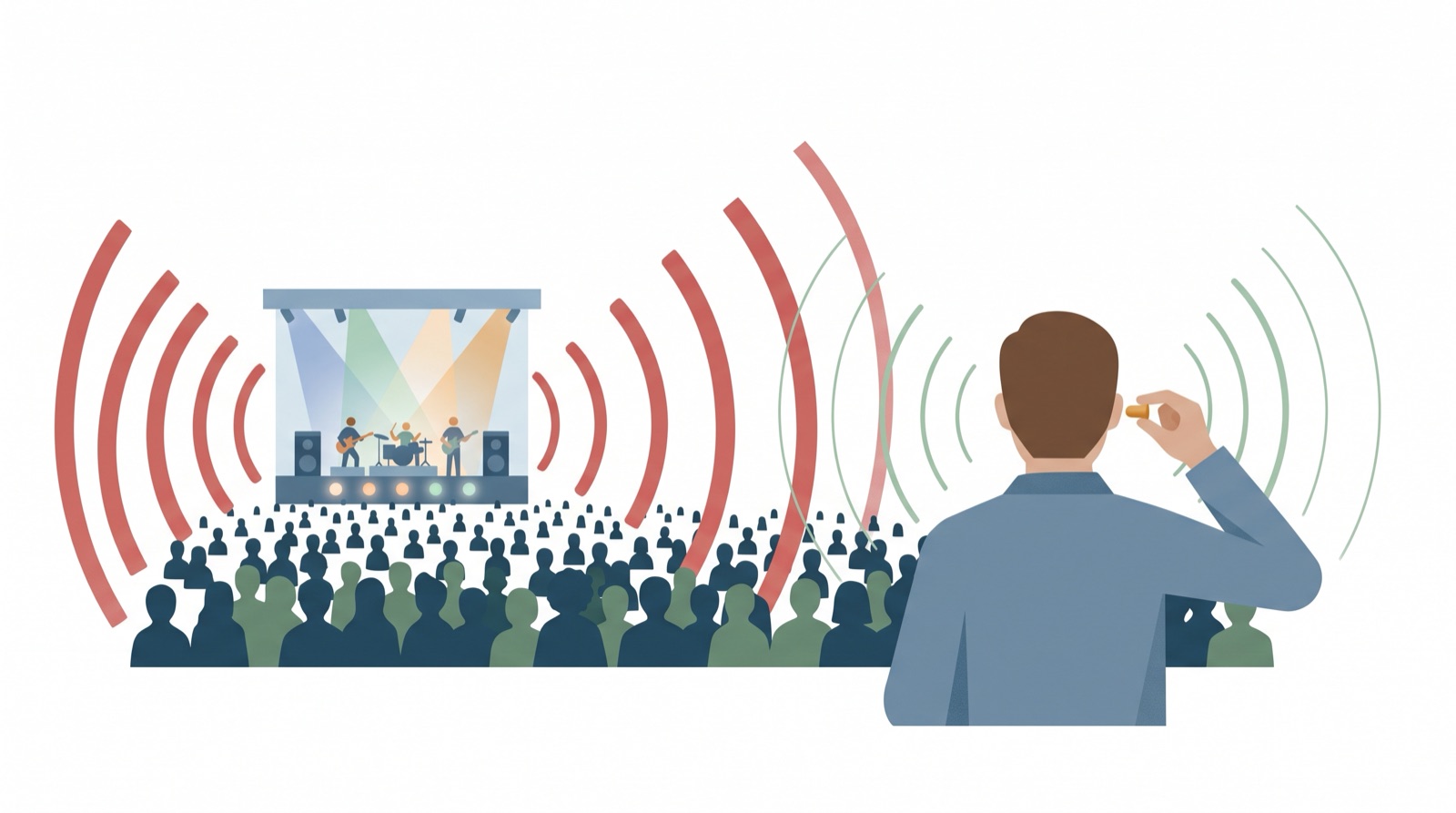
Concerts and clubs run far higher. Measurements of rock concerts and dance venues routinely land above 100 dBA, and a survey of New York City bars, clubs and restaurants found a median of 92 dBA, with 80 percent of venues above 85 dBA and nearly half of the visits using up a full day of NIOSH-allowed dose in one night. Foam earplugs cut roughly 20 to 30 dB and turn a two-hour set from unsafe into unremarkable; musician-style filtered plugs cut less but keep the music balanced.
Power tools sit in the same band: a circular saw or angle grinder runs 100 to 110 dB at the operator position, which is minutes, not hours. Distance is the cheapest protection there is, since sound pressure drops about 6 dB each time you double your distance from a point source. Commuting is the opposite case. 75 to 85 dB on a subway platform will not hurt you in a twenty-minute trip, but it eats into the same daily budget. For the full range, from a whisper to a jet engine, see the decibel chart.
Safe levels for sleep and for children
Sleep is judged by a different standard, because the issue is disturbance rather than hearing damage. WHO guidance for community noise puts the bedroom target at under 30 dB of steady sound, with single events kept below about 45 dB. The Night noise guidelines for Europe set an outdoor target of 40 dB Lnight at the facade, assuming a partly open window loses about 15 dB. The 2018 Environmental noise guidelines for the European Region recommend keeping night-time road traffic below 45 dB Lnight.
For infants, the number people search for is the white noise one. A 2014 Pediatrics study, Infant Sleep Machines and Hazardous Sound Pressure Levels, measured fourteen sleep machines at maximum volume and found all of them exceeded 50 dBA at 30 cm, the sound limit recommended for hospital nurseries; three exceeded 85 dBA. Aim for 50 dBA or less at the crib mattress, place the machine across the room rather than on the rail, and never run it at maximum. Measure at the crib rather than at the machine: the gap between those two positions is usually more than 10 dB.
How loud can sound get?
Pain generally begins around 120 to 130 dB, and a single exposure at or above 120 dB can cause immediate, permanent damage without any warning discomfort. At 140 dB, a jet engine at close range or a gunshot, injury is effectively instantaneous, which is why impulse noise is regulated by a peak ceiling rather than an average.
Whether decibels can kill you is really a question about blast, not about sound as most people experience it. Blast injury comes from overpressure, and the figures live in pounds per square inch rather than on the dB scale: NIOSH figures on blast pressure put eardrum rupture near 5 psi, the lung damage threshold near 15 psi, and fatalities in the 35 to 65 psi range. Those pressures correspond to roughly 190 dB and up. Nothing in ordinary life, including the loudest speaker stack, comes close. The realistic risk from everyday noise is hearing loss, not death.
Check your own environment
Numbers on a page do not tell you about your workshop, your office or your bedroom. Measuring takes a minute: open a noise meter, hold the device where your head normally sits, and watch the average rather than the peak, since the average is what the exposure limits are built on. For a bedroom, leave the window as it usually sits and let the meter run for several minutes so passing traffic is included.
One caveat on accuracy. A phone or laptop microphone is not a calibrated instrument, so browser and app readings are estimates, usually within a few decibels of a real meter at mid-range levels and less reliable at the extremes. That is fine for telling a 60 dB room from a 95 dB one, and not fine for an OSHA citation or a noise ordinance dispute, which need a certified Type 1 or Type 2 meter. Our guide to measuring decibels covers technique and calibration, and if the units are unfamiliar, start with what a decibel actually is. The scale is logarithmic, which is why 3 dB matters far more than it sounds like it should.
Frequently asked questions
Is 70 dB too loud?
No. 70 dB is roughly a vacuum cleaner or street traffic from the sidewalk, well below the 85 dBA level where NIOSH starts counting exposure time. A full day at 70 dB carries no measurable risk of hearing loss. It is still loud enough to interrupt conversation and sleep, which is a comfort problem rather than a hearing one.
How many decibels is too loud for neighbors at night?
WHO guidance is written around the bedroom, not the property line: under 30 dB of steady sound indoors, with single events kept under about 45 dB, and an outdoor target of 40 dB Lnight at the facade. US cities set their own numeric limits, commonly 45 to 55 dBA at the property line after 10 p.m., so check your local ordinance for the number that actually applies.
What decibel level requires hearing protection?
In a US workplace, an eight-hour average of 85 dBA triggers OSHA hearing conservation requirements including employer-provided protectors, and protection becomes mandatory above the 90 dBA permissible exposure limit. Outside work the practical rule is the same: wear plugs or muffs anywhere you have to raise your voice to be heard at arm length, which usually means 90 dB or above.
How loud should white noise be for a baby?
Keep it at or below 50 dBA measured where the baby's head rests, the limit recommended for hospital nurseries and the benchmark used in the 2014 Pediatrics study of infant sleep machines. Place the machine across the room rather than on the crib rail, and avoid maximum volume: three of the fourteen machines tested exceeded 85 dBA at close range.