What Is a Decibel? The dB Scale Explained Simply
Published
A decibel (dB) is the unit used to measure how loud a sound is. On the scale used for sound, 0 dB is roughly the quietest thing a human ear can detect, a whisper sits around 30 dB, normal conversation runs about 60 dB, and a rock concert reaches 110 dB. Higher number, louder sound.
The catch is that the scale does not climb the way most scales do. Going from 60 to 70 dB is not a small nudge; it is ten times more sound energy hitting your ear. Once that clicks, the rest of the scale makes sense, and you can check any of these numbers against your own room with a decibel meter online in about ten seconds.
The word itself is a clue. A decibel is one tenth of a bel, a unit named after Alexander Graham Bell and invented at Bell Laboratories in the 1920s to describe signal loss along telephone cables. The bel turned out to be too coarse for everyday use, so engineers cut it into tenths. That is the whole decibel abbreviation: deci (one tenth) plus B (bel).
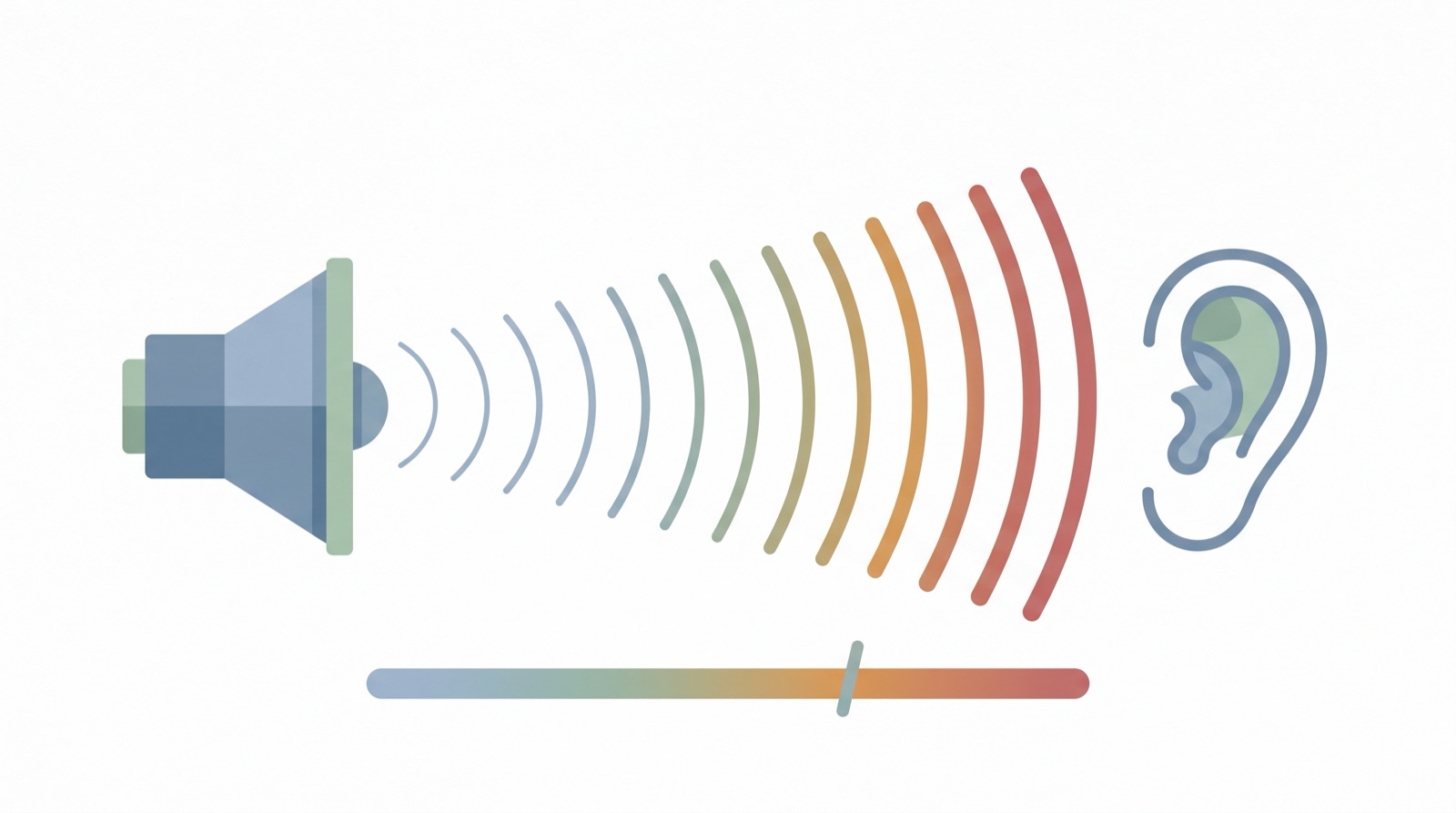
Why is the scale logarithmic?
Human hearing covers an absurd range. The quietest sound you can detect and a sound loud enough to hurt differ in energy by a factor of about a trillion. Writing that on a normal scale would mean numbers from 1 to 1,000,000,000,000, which is useless for a reading on a screen or a sign on a factory wall.
A logarithmic scale squashes that range into two or three digits. Every 10 dB you add multiplies the sound energy by ten. So 0 to 140 dB covers the entire span of human hearing, from the threshold of detection to the threshold of pain, in numbers a person can actually say out loud.
There are two rules of thumb worth memorizing, and they are different rules. Ten more decibels means ten times the energy, which most listeners describe as about twice as loud. Three more decibels means double the energy, but your ear barely registers it. That gap between physics and perception is why the 3 dB rule matters in safety regulations while the 10 dB rule matters when you are describing what something sounds like.
- 60 dB1× — normal conversation
- 70 dB10× the energy
- 80 dB100×
- 90 dB1,000×
| Change in level | Change in sound energy | What you actually hear |
|---|---|---|
| +1 dB | 1.3x | Usually not noticeable |
| +3 dB | 2x | Just barely noticeable |
| +6 dB | 4x | Clearly louder |
| +10 dB | 10x | About twice as loud |
| +20 dB | 100x | About four times as loud |
This also explains something that confuses people the first time they run into it: decibels do not add up. Two machines each running at 60 dB do not make 120 dB. They make about 63 dB, because you are doubling the energy, and doubling the energy is a 3 dB step.
The decibel formula
Sound is a pressure wave, so a sound level meter measures pressure and converts it. The formula, shown once and then never needed again for anything in this article:
dB SPL = 20 × log₁₀(p / p₀)
Here p is the sound pressure being measured and p₀ is the reference pressure, fixed by international agreement at 20 micropascals, or 0.00002 pascals. That reference is roughly the faintest sound a healthy young ear can pick up at 1,000 Hz. SPL stands for sound pressure level, which is the flavor of decibel used for airborne sound.
Two things follow from that formula. First, 0 dB is not silence, it is the point where the measured pressure equals the reference pressure, so the ratio is 1 and the logarithm is 0. Sounds quieter than the reference get negative decibel values. Second, the multiplier is 20 rather than 10 because energy goes up with the square of pressure, which is why doubling the pressure gives you 6 dB while doubling the energy gives you 3 dB.
dB, dBA and dBC: what the A means
Your ear is not equally sensitive to every pitch. A deep 50 Hz rumble and a 1,000 Hz tone at the same physical pressure do not sound equally loud; the rumble sounds much quieter. A microphone does not know that. It reports whatever pressure arrives.
Weighting curves fix the mismatch. A weighting curve is a filter applied to the measurement that turns some frequencies down before the number is calculated, so the result tracks what a person would say they heard.
- A-weighting (dBA) cuts the bass heavily and trims the far treble, mimicking the ear at ordinary listening levels. It is the default on essentially every meter.
- C-weighting (dBC) is nearly flat and keeps the low frequencies. It is used for very loud sounds and peak impacts, where the ear responds more evenly, and for bass complaints from clubs and concerts.
- Z-weighting (dBZ) is no weighting at all, a flat measurement of what the microphone received. It is a laboratory setting more than a practical one.
Regulations use A-weighted decibels because they predict hearing damage better than raw pressure does. NIOSH specifies A-weighting for both sound level meters and dosimeters and writes its exposure limit in dBA, and OSHA does the same. When you see a noise limit in an ordinance, a workplace rule or a product spec sheet and it does not say which weighting, it is almost always dBA. Our meter reads the raw, unweighted microphone signal and lets you calibrate it against a reference, so its readings track dBA closely for the mid-frequency sounds that dominate everyday noise. The guide to how to measure decibels covers what that means for the number on your screen.
Decibels in real life
Numbers on a scale mean nothing until you attach them to sounds you know. These are approximate, because real levels depend on distance and the room, but they are the anchors worth carrying around:
| Sound | Level (dBA) |
|---|---|
| Whisper at a few feet | 30 |
| Quiet library or bedroom at night | 40 |
| Normal conversation | 60–70 |
| City traffic from the sidewalk | 80 |
| Motorcycle or power tools | 90–100 |
| Rock concert or nightclub | 110 |
The NIH puts normal conversation at 60 to 70 dBA and motorcycles at 80 to 110 dBA. Notice how far apart those are in real terms: a concert at 110 dB is 50 dB above conversation, which is 100,000 times the sound energy and something like 30 times as loud to your ear. For a longer list, including appliances, sirens and aircraft, see the full decibel chart.
When do decibels start to matter?
The practical reason to know any of this is hearing damage. Sounds at or below 70 dBA are unlikely to hurt your hearing no matter how long they last. Above that the risk starts, and 85 dBA is the line where it becomes a real concern: NIOSH sets a recommended exposure limit of 85 dBA averaged over an eight-hour day.
The logarithm shows up again in the safety math. NIOSH cuts the allowed exposure time in half for every 3 dBA above 85, because 3 dB is double the energy. So 88 dBA is safe for about four hours, 91 dBA for two, and 100 dBA for around fifteen minutes. That is why a small-looking jump on the display is a big deal, and it is covered in more detail in our guide to safe decibel levels.
One honest caveat. A phone or laptop microphone is not a calibrated instrument. Browser and app readings are good estimates, usually within a few decibels of a real meter for ordinary indoor levels, and they are genuinely useful for deciding whether a room is fine, loud or too loud. They are not evidence. For workplace compliance, a legal noise complaint or anything medical, you want a certified Type 1 or Type 2 sound level meter.
Frequently asked questions
What does dB stand for?
dB is the abbreviation for decibel. The "d" is the metric prefix deci-, meaning one tenth, and the "B" is the bel, a unit named after Alexander Graham Bell. So a decibel is one tenth of a bel. The capital B is part of the name, which is why it is written dB and not db or DB.
Is 10 dB twice as loud as 5 dB?
No. Loudness doubles roughly every 10 decibels, not every time the number doubles. A sound at 10 dB carries about three times the energy of one at 5 dB, and most people would barely call it louder at all. The sound that seems twice as loud as 5 dB is around 15 dB.
What is 0 decibels?
Zero decibels is not silence. It is the reference point of the scale: a sound pressure of 20 micropascals, which is about the quietest sound a healthy young ear can detect at 1,000 Hz. Sounds quieter than that exist and are written as negative decibel values, such as -5 dB.
Are decibels linear or logarithmic?
Decibels are logarithmic. Each 10 dB step multiplies sound energy by ten, so 60 dB carries a thousand times the energy of 30 dB even though the numbers only double. That is why decibel values can never simply be added together: 60 dB plus another 60 dB source is about 63 dB, not 120 dB.