How Loud Is 85 Decibels? Why 85 dB Is the Safety Limit
Published
85 decibels is the line where noise stops being background and starts being a health question. It sounds like heavy city traffic heard from inside a car, a blender or food processor running on the counter beside you, a gas lawn mower you are pushing, or a restaurant busy enough that you lean in to be heard. None of it is painful. That is exactly why the number matters: 85 dB is loud enough to damage hearing over a full day, and quiet enough that nobody thinks to leave the room.
US occupational guidance is built around this figure. NIOSH recommends a maximum of eight hours a day at 85 A-weighted decibels, and OSHA requires employers to start protecting workers at the same level. If you want to know whether your workshop, kitchen or commute is actually reaching it, a db meter running in your browser will give you a reading in seconds.
What does 85 decibels sound like?
There is a field test that works without any equipment, and NIOSH uses it: noise is likely hazardous if you have to raise your voice to talk to someone an arm's length away. That is roughly what 85 dB does to a conversation.
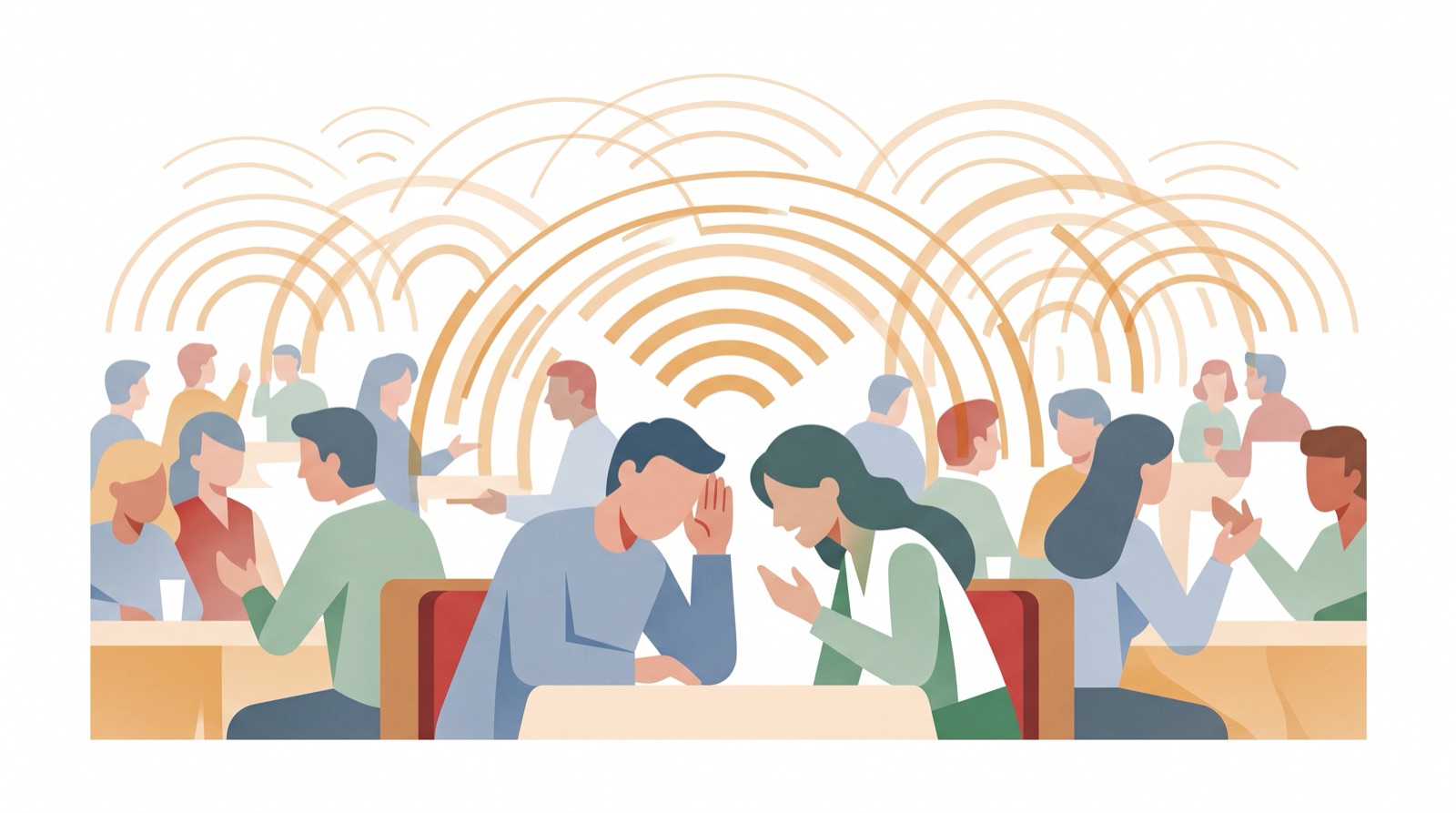
Real examples sit in a band rather than at a point. The CDC puts traffic noise heard from inside a car at about 80 dB, so heavy stop-and-start city driving drifts into the mid-80s. A gas lawn mower is rated across 80 to 100 dB, and pushing one puts your ears near the top of that range. High-speed kitchen motors, blenders and food processors in particular, produce short bursts in the same territory a couple of feet from your head. Busy restaurants and bars routinely pass it: a study of 59 New York venues found a median level of 92 dBA, with 80 percent of them above 85 dBA.
| Level | Examples | NIOSH daily limit |
|---|---|---|
| 75 dB | Vacuum cleaner, busy sidewalk, loud television | No limit |
| 85 dB | Heavy traffic inside a car, blender, lawn mower, noisy restaurant | 8 hours |
| 95 dB | Motorcycle, power saw, nightclub, subway platform as a train arrives | Under 1 hour |
The gap between the rows is larger than it looks. Every 10 dB step is ten times the acoustic energy, so 85 dB carries more than 300 times the energy of the 60 decibels of ordinary conversation, even though it sounds maybe four times as loud. The decibel chart puts the whole scale side by side.
Is 85 decibels safe?
Only for a limited time. The NIOSH recommended exposure limit is 85 dBA averaged over an eight-hour shift, set to prevent hearing loss over a 40-year working life. Above that, NIOSH applies a 3-decibel exchange rate: every 3 dBA increase doubles the sound energy, so the safe duration halves.
- 85 dB8 hours
- 88 dB4 hours
- 91 dB2 hours
- 94 dB1 hour
- 97 dB30 min
- 100 dB15 min
| Level (dBA) | Maximum daily exposure (NIOSH) |
|---|---|
| 85 | 8 hours |
| 88 | 4 hours |
| 91 | 2 hours |
| 94 | 1 hour |
| 97 | 30 minutes |
| 100 | 15 minutes |
The legal picture in the US is looser than the health recommendation. OSHA's permissible exposure limit in 29 CFR 1910.95 is 90 dBA over eight hours with a 5-decibel exchange rate. The same standard sets an action level of 85 dBA as an eight-hour time-weighted average, at which the employer must run a hearing conservation program: monitoring, annual hearing tests and hearing protectors made available. Compliance is therefore not the same as safety, and NIOSH recommends protection whenever levels exceed 85 dBA, to cover the most susceptible part of the population.
Eighty-five decibels is where time starts counting, and where ordinary activities such as mowing, commuting and eating out begin adding to a lifetime dose. Everything below it, down through office noise and the 50 decibels of steady rain, adds essentially nothing. The full ladder of limits is in our guide to safe decibel levels.
How do you check the level yourself?
Measure where your ear is, not where the machine is, and let the meter average over half a minute, because 85 dB is a sustained-exposure number and a single peak says nothing about dose. If a reading sits in the mid-80s during an activity you do for hours, add earplugs or shorten the session. Browser and phone readings are estimates, typically within a few decibels of a calibrated meter, so treat a result near the threshold as a reason to protect your hearing rather than a precise verdict. Workplace compliance needs a certified meter or a dosimeter.
Frequently asked questions
How long can you listen to 85 dB safely?
Eight hours a day, according to the NIOSH recommended exposure limit, which assumes the rest of the day is quiet enough for the ears to recover. Every 3 dBA above 85 halves the allowance: four hours at 88 dBA, two at 91, one at 94, fifteen minutes at 100.
Do I need ear protection at 85 decibels?
For a few minutes, no. For a full working day, yes. OSHA requires employers to run a hearing conservation program, including hearing tests and access to hearing protectors, once an employee averages 85 dBA over eight hours. NIOSH goes further and recommends protection whenever levels exceed 85 dBA, regardless of duration.
Is 85 dB loud enough to cause immediate damage?
No. At 85 dBA the damage is cumulative rather than instant, which is what makes it easy to ignore. Immediate injury takes far higher levels, at or above about 120 dB, such as a firework at close range. The danger at 85 is that hours of it, repeated over years, cause permanent hearing loss without any moment that felt painful.