How Loud Is 60 Decibels? Real Examples of 60 dB
Published
60 decibels is the sound of a person talking to you. Speech at a normal effort, measured about a meter away, lands at 60 dB, and almost every other 60 dB example is something you can talk over without raising your voice: a dishwasher in the same room, background chatter in a half-full restaurant, a sewing machine, an air conditioner heard from across the yard. It is the default volume of ordinary indoor life.
It is also completely safe. Hearing damage is a function of loudness and duration, and 60 dB is too low to accumulate into a harmful dose no matter how many hours it runs. If you want to see where your kitchen, office or living room actually sits, a sound meter online reads it straight from your device microphone with nothing to install.
What does 60 decibels sound like?
The NIDCD puts normal conversation at 60 to 70 dBA, and the CDC quotes a slightly higher 65 to 80 dB band for conversation in general, which reflects how much people lift their voices once a room gets busy. Sixty decibels is the quiet end of that: two people talking across a table in a room with no competing noise. Raise the number by ten and you get the same two people in a crowded bar.
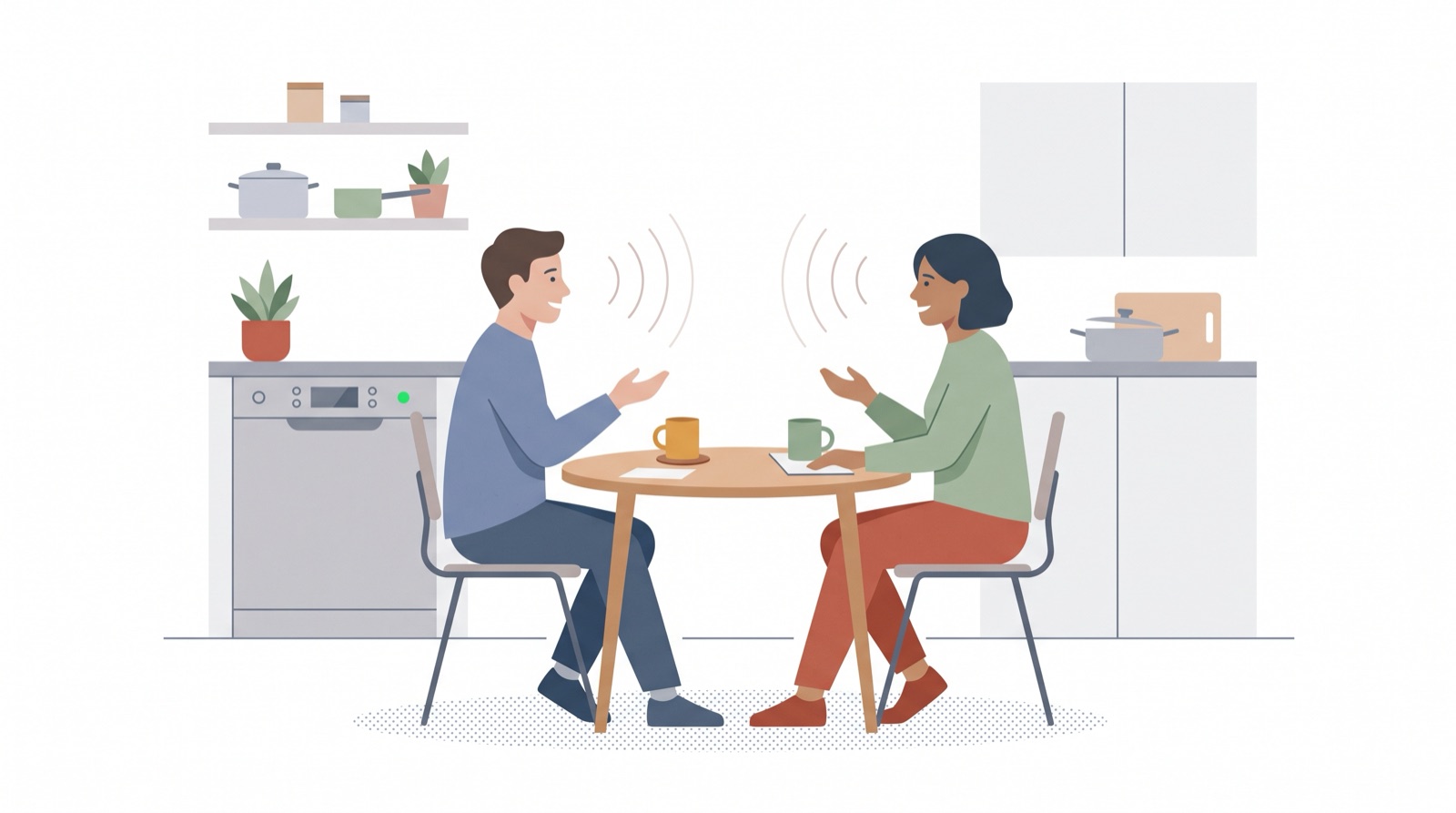
Household machines cluster around this level too. The CDC rates dishwashers at 45 to 65 dB, so a normal wash cycle heard from the kitchen counter is about 60. A domestic sewing machine running steadily is in the same neighborhood, as is a central air conditioning unit measured from roughly a hundred feet away, which is the distance a neighbor hears it from. Restaurants start near 60 dB when they are empty and climb from there: a survey of restaurant dining rooms measured peak-hour levels of 66.7 to 82.6 dBA across Chinese, fast food and Western venues, driven almost entirely by how full the room was.
| Level | Typical sources | Effect on speech |
|---|---|---|
| 50 dB | Moderate rain, quiet office, fridge a few feet away | Can talk quietly across a room |
| 60 dB | Conversation at 1 m, dishwasher, sewing machine, restaurant background | Normal speaking voice works |
| 70 dB | Washing machine, vacuum cleaner, busy road heard from the sidewalk | Slight lift in voice needed |
Those ten-decibel steps each represent ten times the sound energy, though the ear hears them as roughly a doubling. Coming down one step to 50 decibels gives you a room quiet enough to think in; the same distance in the other direction is a vacuum cleaner. A wider spread of everyday sources is laid out in the decibel chart.
Is 60 decibels safe?
Yes, with no time limit attached. The NIDCD is explicit that sounds at or below 70 dBA are unlikely to cause hearing loss even after long exposure. The EPA reached the same conclusion from the other direction when it identified 70 dBA averaged over 24 hours as the environmental level that protects hearing across a lifetime. Sixty decibels is a tenth of the energy of 70, so a day spent entirely at 60 dB uses a trivial fraction of any exposure budget.
The number that does matter is 85. NIOSH recommends no more than eight hours a day at 85 decibels, and cuts that time in half for every 3 dB above it. Sixty decibels is 25 dB below that threshold, which on a logarithmic scale is not a near miss but a different category of sound. Our summary of safe decibel levels lays out where each limit comes from.
- 0 dBthreshold of hearing
- 10 dBnormal breathing
- 20 dBticking watch
- 30 dBwhisper
- 40 dBrefrigerator hum
- 50 dBmoderate rainfall
- 60 dBnormal conversation
- 70 dBwashing machine
- 80 dBcity traffic
- 90 dBgas lawn mower
- 100 dBnightclub
- 110 dBrock concert
- 120 dBsiren up close
- 130 dBmilitary jet nearby
- 140 dBgunshot, jet takeoff
Safe for hearing is not the same as welcome. Sixty decibels still interferes with sleep, recordings and verbal concentration, which is why libraries and studios aim far lower than the health guidelines require.
How do you check the level yourself?
A reading only means something with a distance attached, so decide where you are measuring first: the dining table, the head of the bed, or the property line if you are documenting a neighbor complaint. Let it run for at least thirty seconds and use the average rather than the peak, since one cough will spike the display. Browser and phone measurements are estimates, usually within a few decibels of a calibrated meter, which is fine for comparing rooms but not for legal evidence or hearing tests.
Frequently asked questions
Is 60 dB loud for an air conditioner?
It is normal for an outdoor condenser and loud for an indoor unit. Window and portable air conditioners are usually rated in the 50s on their quiet settings, so an indoor unit measuring 60 dB is running hard or needs service. An outdoor compressor heard at 60 dB from across the yard is unremarkable.
Can 60 decibels damage hearing?
No. The NIDCD states that sounds at or below 70 A-weighted decibels are unlikely to cause hearing loss even after long exposure, and 60 dB sits under that. Risk begins at 85 dBA over an eight-hour day, which carries more than 300 times the sound energy of 60 dB.
Is 60 dB loud enough to disturb sleep or neighbors?
It can be, even though it is harmless to hearing. Sixty decibels is roughly the level of a conversation happening in your room, and most people find that hard to sleep through. US cities generally set stricter residential noise limits at night than during the day, so 60 dB carrying across a property line at midnight is often over the local ordinance even though it poses no hearing risk.