How Loud Is 50 Decibels? Real Examples of 50 dB
Published
50 decibels is quiet. It is the sound of steady rain on a window, a refrigerator humming in the next room, or an office where a few people are working without talking. You can hold a conversation at a normal voice over 50 dB without effort, and you can concentrate through it. Nothing about the level is hazardous: hearing damage starts far higher, around 85 dB, and sounds at or below 70 dBA are considered safe no matter how long they last.
The catch is that 50 dB is not the same as silence, and at night that difference matters. It sits above the level health agencies recommend for a bedroom and above the level the EPA identified for indoor comfort, which is why a 50 dB air handler or a 50 dB street outside a window can still feel intrusive at 2 a.m. If you want to know what your own room measures, a free decibel meter in your browser will tell you in a few seconds.
What does 50 decibels sound like?
Most of the sounds people identify as 50 dB are continuous and low in character rather than sharp. Moderate rainfall is the classic example. So is a refrigerator heard from a few feet away, a dishwasher running behind a closed kitchen door, or the general hum of a quiet suburban street on a weekday afternoon with no traffic passing. A quiet open-plan office with ventilation running and keyboards in use tends to hover right around the same figure between meetings.
Appliance ratings are a useful sanity check. The CDC lists a refrigerator at roughly 40 dB and dishwashers across a 45 to 65 dB range, so a dishwasher you can hear but not identify from the next room is close to 50 dB by the time it reaches you. Distance does most of that work: the machine that reads 60 dB standing in front of it drops to the low 50s once a doorway and a few yards are in the way.
| Level | Sounds like | How it feels |
|---|---|---|
| 40 dB | Refrigerator, library reading room, quiet bedroom at night | Background you stop noticing |
| 50 dB | Moderate rainfall, quiet office, dishwasher two rooms away | Audible, easy to talk and think through |
| 60 dB | Normal conversation at arm's length, a dishwasher in the same room | Clearly present, still comfortable |
Each step in that table is ten decibels, which is ten times the sound energy and roughly double the perceived loudness. That is why the jump from 50 dB to 60 decibels feels like a room waking up rather than a small adjustment. For the full range from a whisper to a jet engine, see the decibel chart.
Is 50 decibels loud or dangerous?
It is neither. Hearing risk is level multiplied by time, and 50 dB never accumulates into a dose that matters. NIOSH sets its recommended occupational limit at 85 dBA averaged over an eight-hour shift, and the EPA identified 70 dBA averaged over 24 hours as the level below which hearing loss is not a concern at all. The arithmetic only starts to bite at 85 decibels, and the full set of thresholds is in our guide to safe decibel levels.
- 0 dBthreshold of hearing
- 10 dBnormal breathing
- 20 dBticking watch
- 30 dBwhisper
- 40 dBrefrigerator hum
- 50 dBmoderate rainfall
- 60 dBnormal conversation
- 70 dBwashing machine
- 80 dBcity traffic
- 90 dBgas lawn mower
- 100 dBnightclub
- 110 dBrock concert
- 120 dBsiren up close
- 130 dBmilitary jet nearby
- 140 dBgunshot, jet takeoff
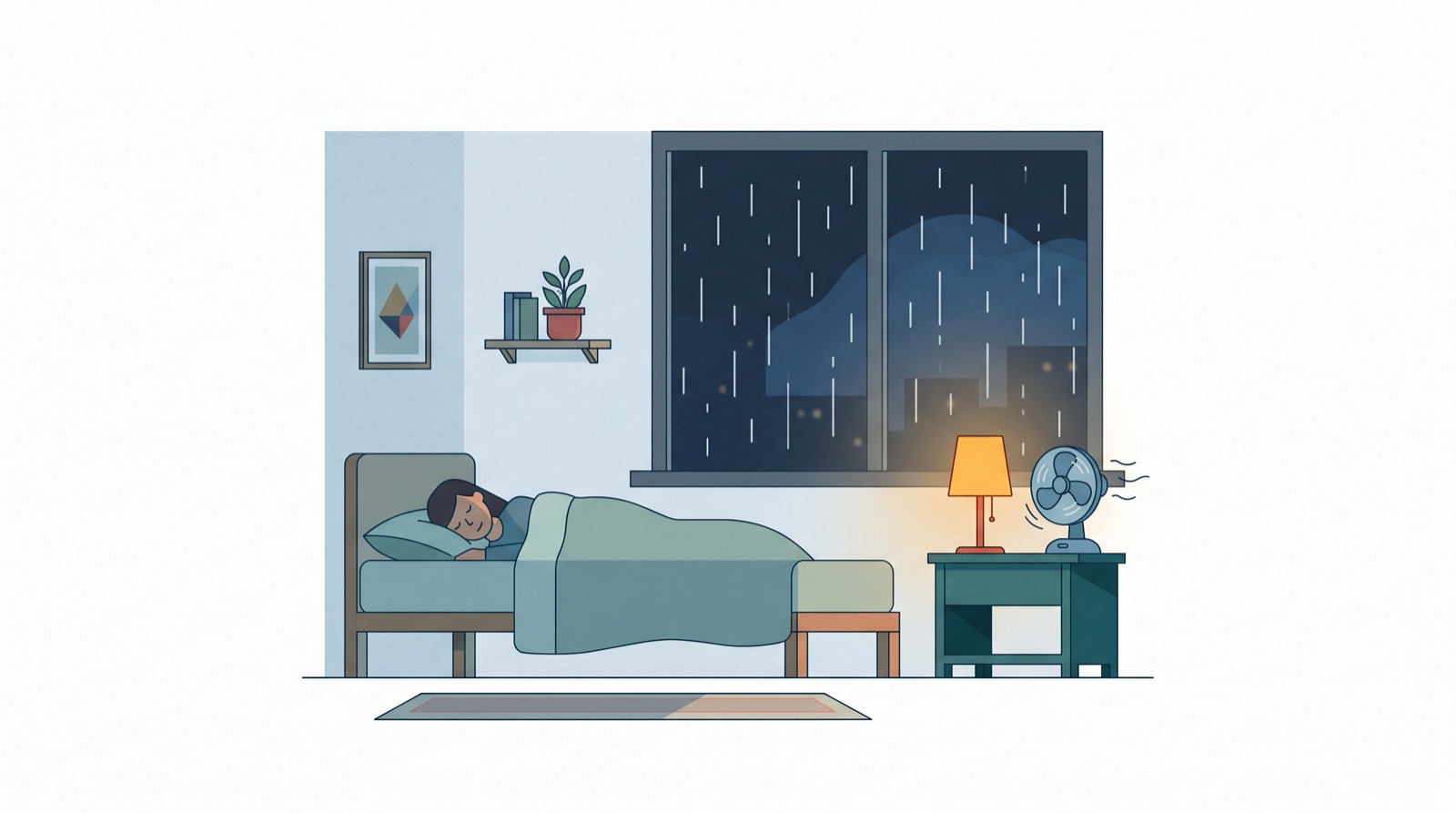
Annoyance and sleep carry lower numbers. The same EPA levels document put 45 dBA indoors and 55 dBA outdoors as the points beyond which noise interferes with speech and daily activity. The WHO goes further for bedrooms, recommending less than 30 dB(A) at night for good sleep quality, with its night noise guideline set at 40 dB Lnight outside the building. Measured against those, 50 dB is a little high for a bedroom and unremarkable for a living room.
What wakes sleepers is contrast, not the average. A quiet room punctuated by a 50 dB event disturbs more than a room that sits at 50 dB all night, which is the reasoning behind white noise machines.
How do you check the level yourself?
Measure at head height where you actually sit or sleep, hold still for thirty seconds so the average settles, then take a second reading with the suspected source switched off to see what the room contributes on its own. Phone and browser readings are estimates, usually within a few decibels of a calibrated instrument, which is plenty for judging a noisy fridge but not for anything legal or medical.
Frequently asked questions
Is 50 dB too loud for sleeping?
For most people, no. The World Health Organization recommends bedrooms stay below 30 dB(A) for undisturbed sleep, so 50 dB is above the ideal, but most sleepers adapt to it when it is steady, like rain or a fan. Sudden 50 dB events, such as a door closing, wake people far more reliably than constant 50 dB hum.
Is 50 decibels loud for a fridge?
It is on the loud side. The CDC puts a refrigerator at about 40 dB, and most modern models are rated in the high 30s to mid 40s. A fridge reading 50 dB from a few feet away is louder than average, which usually points to a hard-working compressor, a worn fan, or an appliance that is not level.
What is the difference between 50 dB and 60 dB?
Ten decibels is ten times more sound energy, and people hear it as roughly twice as loud. In practice, 50 dB is a room you can think in and 60 dB is a room where someone is talking. Both are far below the level at which noise threatens hearing.