How Loud Is a Gunshot? Decibel Levels of Extreme Sounds
Published
A gunshot peaks between roughly 140 and 175 decibels. That is above the threshold of pain, far above the level at which hearing damage becomes gradual, and loud enough to injure the inner ear in the fraction of a second the blast lasts. NIOSH puts most recreational firearms between 150 and 165 dB peak, with small-caliber rifles at the bottom of the range and large-caliber rifles with muzzle brakes above the top of it.
These are not levels you can check for yourself. A phone microphone, and the sound decibel meter on this site along with it, saturates roughly 40 dB below a gunshot, so every figure below comes from research-grade instruments built for impulse noise. What consumer tools are good for is the tier underneath: concerts, traffic, machinery, the rooms you spend hours in.
Gunshot decibel levels by firearm
Peak levels vary with caliber, barrel length, powder load, muzzle devices and whether you are shooting indoors. These figures come from NIOSH firearm noise measurements and are peak sound pressure levels at the shooter's ear.
| Firearm | Typical peak (dB) |
|---|---|
| .22 caliber rifle | 140–145 |
| .22 caliber pistol | 150–155 |
| 9 mm handgun | 155–162 |
| .223 / 5.56 rifle | 155–165 |
| 12-gauge shotgun | 160–170 |
| .357 magnum revolver | up to 172 |
| .30 caliber rifle with muzzle brake | above 175 |
Two details matter more than the exact numbers. The first is that this is peak sound pressure, not the averaged level a meter shows for steady noise. A gunshot is impulse noise: the pressure rises to its maximum in under a millisecond and is gone in a few. An averaging meter would report something unremarkable, which is why impulse noise is regulated on peak level instead.
The second is that the same acoustic energy is far more dangerous delivered as an impulse than spread over minutes. Slow noise damages hearing mainly by metabolic exhaustion of the hair cells. An impulse this steep damages it mechanically, tearing structures in the cochlea outright. Indoors it gets worse, because the walls of a range reflect the blast back and add several decibels to what reaches the ear.
Why can one shot damage hearing permanently?
NIOSH recommends that peak impulse noise never exceed 140 dB, and OSHA's noise standard (29 CFR 1910.95) sets the same ceiling. A single event at 140 dB uses up an entire day's allowable noise exposure. Since essentially every firearm starts at 140 dB and most sit 10 to 25 dB above it, one unprotected shot is enough. ASHA puts it plainly: impulse noise above 140 dB peak can permanently damage hearing from a single occurrence, in less than a second, with no warning.
Because decibels are logarithmic, the gap between a firearm and the everyday limits is larger than it looks. A 165 dB shot carries around a thousand times the sound pressure of the 85 dB where safe noise exposure limits begin to run out after eight hours. Nothing about the arithmetic scales gently.
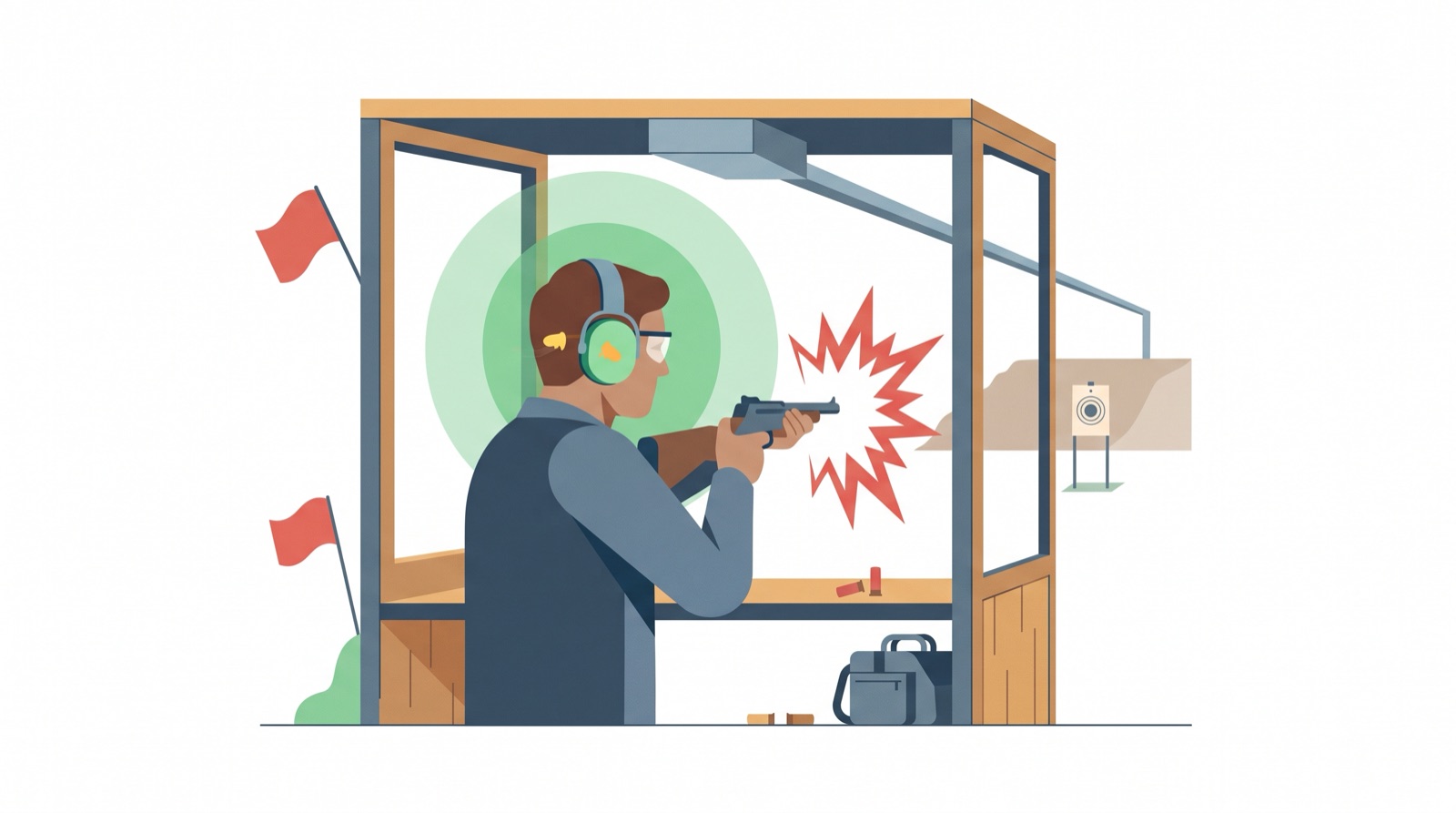
The practical answer is double protection. NIOSH recommends a deeply inserted foam earplug worn underneath a well-seated earmuff every time a firearm is fired. Plugs alone cut peak levels by roughly 10 to 30 dB and muffs by 20 to 38 dB; worn together they overlap enough to bring most shots near or below the limit. Fit does most of the work. A plug inserted halfway gives up a large share of its rating.
Suppressors help and are worth having, but they do not make a firearm hearing-safe. A NIOSH study of suppressors and low-velocity ammunition found reductions of roughly 20 to 35 dB, which still leaves many shots above 140 dB. Supersonic ammunition also produces a sonic crack from the bullet itself, and no suppressor affects that. The study's conclusion was that suppressed firearms can still present a significant hearing risk and that shooters should wear protection regardless.
How do gunshots compare to other extreme sounds?
Distance is part of every number here. Sound drops about 6 dB each time the distance doubles, so a level quoted at three feet and one quoted at a hundred feet describe very different experiences of the same event.
- Rock concert94–110 dB
- Train horn96–110 dB
- Ambulance siren~120 dB
- Jet engine at takeoff~140 dB
- Consumer fireworks~150 dB
- Gunshot140–175 dB
- Rocket launch~180 dB
| Sound | Level (dB) | Where measured |
|---|---|---|
| Rock concert | 94–110 | In the crowd; higher near the speaker stacks |
| Train horn | 96–110 | 100 ft ahead of the locomotive (FRA limits) |
| Sonic boom | ~100–110 | Perceived level on the ground under the flight path |
| Ambulance siren | ~120 | Close to the vehicle |
| Jet engine at takeoff | ~140 | Standing near the aircraft |
| Consumer fireworks | ~150 | 3 ft from the shell |
| Gunshot | 140–175 | At the shooter's ear |
| Rocket launch | ~180 | At the pad |
The train horn range is a regulation, not an estimate. 49 CFR 229.129 requires a lead locomotive horn to produce at least 96 dB(A) and no more than 110 dB(A) measured 100 feet ahead of the locomotive. Sonic booms are quoted in perceived level rather than plain decibels because their energy sits at very low frequencies; Concorde rated around 102 to 105 PLdB, and NASA's X-59 is designed to land near 75, closer to a car door closing down the street.
Everything in that table above the siren row is impulse noise or close to it. Everything below it is the territory where exposure time decides the outcome, which is the world most people actually live in — see the decibel chart of everyday sounds for how far down the scale that goes, and what 85 decibels sounds like for the level where damage starts to accumulate over a working day rather than in a single instant.
The loudest sounds ever recorded
The 1883 eruption of Krakatoa is the loudest sound in recorded history. A pressure gauge in Batavia, about 100 miles away, traced a spike corresponding to roughly 172 dB. The blast was heard nearly 3,000 miles away on Rodrigues island, sailors 40 miles out had their eardrums ruptured, and barographs around the world recorded the pressure wave circling the planet several times over the following days. The figure is a reconstruction from those barometer traces rather than a meter reading, so treat it as an informed estimate.
There is a hard ceiling not far above it. In air at sea level, an undistorted sound wave cannot exceed about 194 dB, because at that point the rarefaction half of the wave has given up a full atmosphere of pressure and is a vacuum. Pressure can keep climbing on the compression side, but there is nothing left to take away on the other, so the wave stops behaving like sound. Waves already start deforming above roughly 150 dB, so 194 is the end of a slope rather than a wall.
Past that limit, energy moves as a shock wave: air molecules shoved along wholesale instead of oscillating in place. This is why the numbers sometimes quoted for large explosions, like the 200-plus decibel figures attached to nuclear tests, are blast overpressure measurements converted to a decibel scale rather than sound levels anyone could hear. At those pressures the injury is not to hearing but to lungs and other soft tissue.
Measuring loud environments
Consumer microphones cannot measure any of this. Phone and laptop mics are built for speech and typically clip somewhere around 100 to 110 dB, which means a gunshot, a firework or a jet at close range all read the same: pinned at the top of the scale. Anyone quoting a gunshot figure from a phone app is reporting the ceiling of the microphone, not the sound. Real impulse measurement needs a meter rated for peak SPL and a microphone that holds linear well past 170 dB.
Below that ceiling a browser meter is genuinely useful. Concerts, bars, gyms, traffic, power tools and workshops all sit in the range where a phone reading lands within a few decibels of the truth, and a few decibels is enough to tell you whether you need protection and for how long. For anything legal, medical or occupational, a calibrated Type 1 or Type 2 meter is still the instrument that counts.
Frequently asked questions
How many decibels is a gunshot with a suppressor?
A suppressor typically takes 20 to 35 dB off the peak level, so a 165 dB rifle shot lands somewhere around 130 to 145 dB. NIOSH measurements found many suppressed shots still above the 140 dB peak limit, especially with supersonic ammunition and short barrels, because the bullet itself makes a sonic crack the suppressor cannot touch. Suppressed firearms are quieter, not hearing-safe, and hearing protection is still required.
Can a gunshot cause instant hearing loss?
Yes. Impulse noise above 140 dB peak can permanently damage the hair cells in the cochlea from a single exposure lasting less than a second. One unprotected shot can leave ringing, muffled hearing or permanent high-frequency loss. The damage is not always obvious on the day it happens, and it does not heal.
What is the loudest sound possible in air?
About 194 dB at sea level. At that level the low-pressure half of the wave has given up a full atmosphere of pressure and is effectively a vacuum, so the wave cannot get any larger and stay a sound wave. Anything more energetic travels as a shock wave, which is why blast figures quoted for large explosions are pressure measurements rather than sound levels.
How many decibels was Krakatoa?
The 1883 eruption of Krakatoa registered roughly 172 dB on a pressure gauge about 100 miles away in Batavia, now Jakarta. The blast was heard nearly 3,000 miles away on Rodrigues island in the Indian Ocean, and the pressure wave circled the planet several times. It is the loudest sound in recorded history, though the figure is reconstructed from barometer traces rather than measured with a sound level meter.