Classroom Noise Level Monitor: Free Online Meter for Teachers
Published
A noise meter on the projector changes the argument in a classroom. Instead of you telling the room it is too loud, the room can see it is too loud. The number is on the wall, it moves when they move, and nobody has to take your word for it. Our online noise meter for classroom use is free, opens in a browser tab, and needs no install, no account and no ads.
It works on whatever the school gave you: a Chromebook, an aging Windows desktop wired to a projector, an iPad, a smartboard. Open the page, allow the microphone once, go full screen. The reading is an estimate rather than a calibrated measurement, which is fine here. For classroom management you care about the trend and the threshold, not about a tenth of a decibel.
How loud should a classroom be?
The published standards describe empty rooms. ANSI/ASA S12.60, the US standard for school acoustics, requires core learning spaces to sit at or below 35 dBA of background noise when unoccupied, with reverberation under 0.6 seconds. The WHO reaches the same 35 dB figure for classrooms, on the logic that a casual speaking voice lands near 50 dBA and needs roughly 15 dB of headroom over the noise floor to be understood.
No occupied classroom hits 35 dB, and it is not a target for your lesson. When Wang and Brill logged six school days in 220 US K-12 classrooms, published in the Journal of the Acoustical Society of America, speech averaged 66 dBA and non-speech activity averaged 49 dBA. The ranges below are working targets built on those measurements: loud enough to be realistic, quiet enough that a voice still carries. For how these compare to sounds outside school, see the full decibel chart.
- Silent testunder 40 dB
- Independent work40–50 dB
- Partner talk50–60 dB
- Group work60–70 dB
- Transitions70–80 dB
| Activity | Target level | What it sounds like |
|---|---|---|
| Silent test | Under 40 dB | Ventilation, pencils, a chair shifting |
| Independent work | 40–50 dB | Page turns, a whisper to a neighbor, the teacher moving around |
| Partner talk | 50–60 dB | One quiet conversation per pair, nobody leaning across the room |
| Group work | 60–70 dB | Six conversations at once, still able to hear your own group |
| Transitions and cleanup | 70–80 dB, briefly | Chairs, bags, everyone standing up at the same time |
One thing to know about the numbers: decibels are logarithmic, so 70 dB is not slightly louder than 60 dB, it is roughly twice as loud to the ear. The gap between your group-work target and the level the room drifts to is bigger than it looks.
Setting up a noise meter on your projector
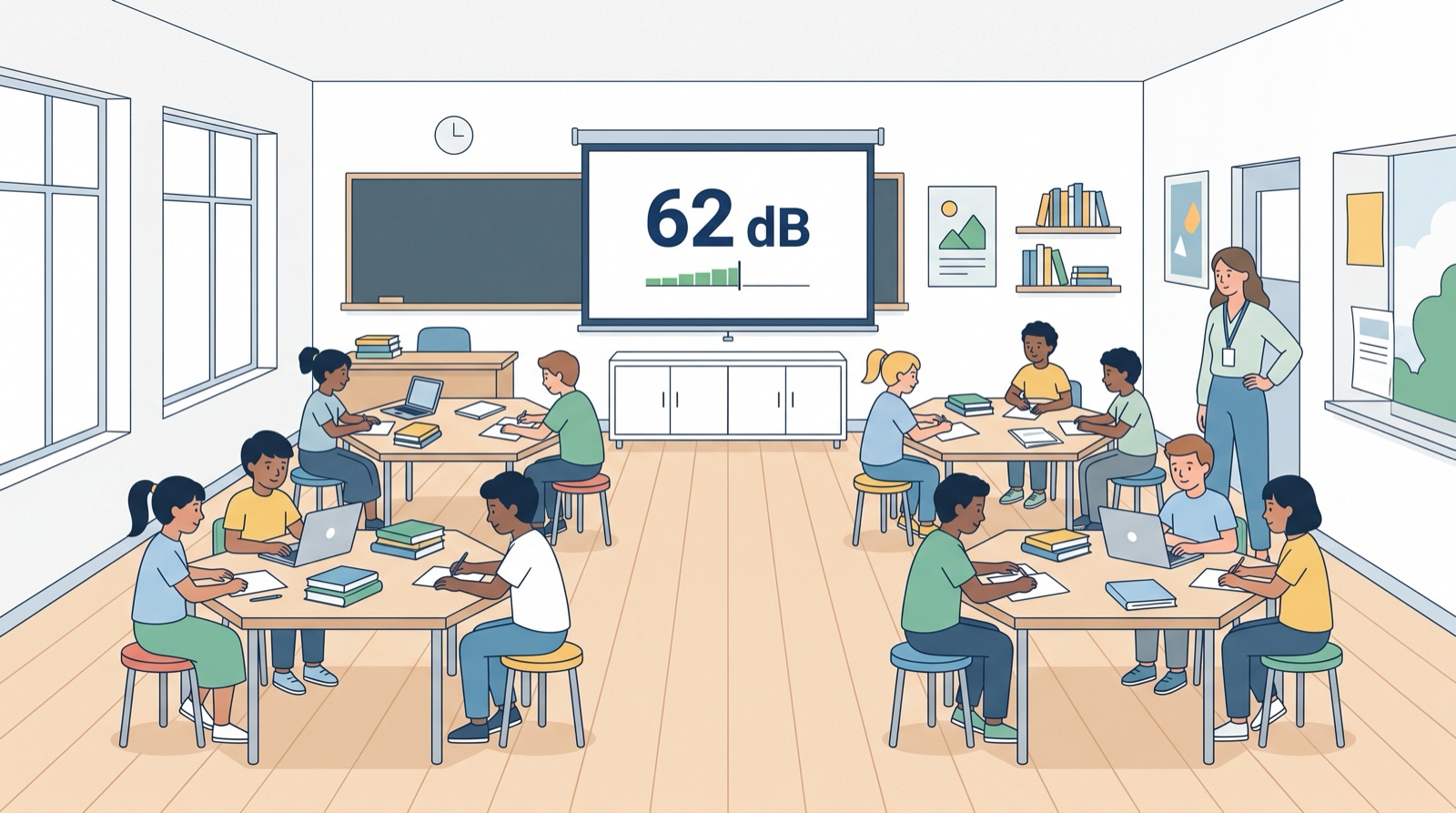
Open the noise meter for classroom on the computer that drives the projector or smartboard. Allow the microphone when the browser asks. Grant it permanently so you are not clicking through the prompt every period. Then put the browser in full screen and mirror or extend to the display.
The large live number and the level graph are readable from the back of the room, which is the whole point. Check it from a back corner desk on the first day and adjust the projector zoom if the digits are small. Keep the laptop lid open and clear so the microphone is hearing the room rather than a stack of worksheets. If the classroom computer lives in a cupboard, a cheap USB microphone on the desk beats a built-in one next to a fan.
Then agree the thresholds with the class before you use them. Say the number out loud: keep it under 65 during group work, under 45 during independent reading. A threshold the class helped set is a rule. A threshold you announced mid-lesson while annoyed is a punishment.
Classroom routines that make it stick
The meter is only useful if students look at it without being told to. A few things help.
Hand the monitoring to them. Name a noise captain for the week whose job is to raise a hand, not a voice, when the level sits above the agreed number. The correction comes sideways instead of down, and it is one less thing you are doing while circulating.
Set the threshold per activity and change it out loud. If the room keeps one target all day, students learn the meter means quiet rather than appropriate. Announce the new number when the activity changes, the same way you announce a time limit.
Ignore the spikes. A laugh, a dropped binder or a chair scrape will jump the reading 20 dB for a second. That is not misbehavior, it is physics, and calling it out teaches students the meter is arbitrary. Respond to the level that stays up for a minute or more.
Build in reset moments. Thirty seconds of everyone silent, watching the number fall, works better than asking for quiet, because the class gets feedback the instant it works.
Why does noise matter for learning?
Speech intelligibility depends on the gap between a voice and the background, not on the voice alone. Normal-hearing children need roughly 15 dB of signal-to-noise ratio to follow connected speech. Students with hearing loss, students with language or attention difficulties, and students working in a second language need closer to 20 dB. The Wang and Brill measurements found more than a quarter of classrooms short of even the 15 dB figure, and the students hit hardest are the least likely to tell you they missed the instruction.
The effect shows up in outcomes. In a companion study of 178 US classrooms published in Frontiers in Built Environment, each 1 dBA increase in daily non-speech noise was associated with roughly a 0.87 percentile-rank drop in math achievement, after controlling for socioeconomic status and program enrollment. A few decibels is not a rounding error across a school year.
It matters for you too. Teachers speak over the room all day, which is why classroom speech averages 66 dBA rather than the 50 dBA of casual conversation. That is a vocal load, not a hearing risk, and safe decibel levels are worth knowing if you also teach in a gym, a band room or a shop class, where sustained levels climb much closer to the limits.
Frequently asked questions
What is an acceptable noise level in a classroom?
The ANSI/ASA S12.60 standard and the World Health Organization both set 35 dBA as the background level for an empty classroom. That number describes the building, not the lesson, and a room with thirty children in it is always louder. Across 220 US classrooms, non-speech activity averaged 49 dBA and speech averaged 66 dBA. Useful working targets are under 40 dB for a silent test, 40 to 50 dB for independent work, and 60 to 70 dB for group work.
Is there a free noise level meter for classrooms with no ads?
Yes. Sound Decibel Meter is free, has no ads, no accounts and no sign-up. It runs in the browser tab, so there is nothing for a school IT department to approve or install. The microphone audio is processed on the device and nothing is recorded or uploaded.
Does the online meter work on a Chromebook or smartboard?
It works on any device with a modern browser and a microphone, including Chromebooks, laptops, iPads and most interactive smartboards, since Chrome, Edge, Safari and Firefox all support the Web Audio API it uses. On a smartboard with no microphone of its own, run the meter on the computer driving the display and use that computer or a cheap USB microphone as the input.
What decibel level is too loud for students?
For learning, the room is too loud once the background rises to within 15 dB of the teacher voice, which in a typical classroom means sustained levels above roughly 65 to 70 dB during instruction. For hearing safety the threshold is much higher: NIOSH sets 85 dBA over eight hours as the point where damage risk begins. Normal classroom noise rarely reaches that, but gyms, cafeterias, band rooms and shop classes can.